Showing posts with label british. Show all posts

April 25, 2010

Pakistan Zindabad...From London?!?


MQM president Altaf Hussian has announced his plans to solve pakistan's poverty while, get this; sitting his ass down in his comfortable loft in London as a BRITISH CITIZEN! Wow, really now that's something. He is not in Pakistan during Pakistan's hard times and he thinks he has the right to say something like this. And before you try to back him up saying something like: he is in exile and he's really not to blame, well guess what: your dead wrong. Altaf Hussain is in voluntary exile meaning he chooses to stay away from Pakistan. Why would anyone do that? Well in 1992, a warrant was issued for his arrest in connection of murder so he fled first to Saudi Arabia and then later to London. He had 72 cases against him, with 31 on murder and 11 on murder attempts before he was granted amnesty by the infamous and corrupt NRO (National Reconciliation Ordinance) just a year back. So yea, this is the guy who says that he wants to solve Pakistan's problems and the sad thing is that people are actually going to support him. Now why would anyone do that? Well it's quite simple; because we (the public) like to hear and think about change and hope for it to happen, even if we know it's nearly impossible that it will. But what makes this an even funnier move is that his statements weren't even about the whole nation as he was strictly talking about Punjab. He is just looking to extend MQM's political power to Punjab and not at all to improve the public's situation. His calls for dividing wealth and power among the poor (which is by the way communism) is as pointless as the 18th amendment and the renaming of the NWFP (I ♥ this example; so relevant :D). He goes on criticizing the Punjabi politicians saying "Why do people of Punjab keep voting for plunderers and looters who have been tried before?" It's quite ironic because that's exactly who he is! lol. Another point to note is that MQM (Muttahida Qaumi Movement), the party he created, is made to represent the people who emigrated from india in 1947. So what happened to the rest of us Pakistanis? Do we not exist in his party's eyes? Out of all the corrupt politicians i have seen he is clearly the most idiotic one. I mean, at least the others hide their evil ways; he just boasts his. MQM, which hasn't been able to control Karachi where target killings are unfortunately very popular (probably done by his and his rival's parties) has now set their eyes on punjab. That's very alarming and in fact very sad if it actually happens.

[Image: © amnesty.org.uk]

April 9, 2010

Chaos In The Smokers' Den


In a recent discovery, the use of pig blood has been found inside cigarette filters. Communities out all over the world are freaking out, mostly the the Muslim and Jewish communities. Pig is forbidden to both communities as well as many cultures and religions around the world (one good example is india). Outrage among communities is growing throughout. Still, the cigarette companies are keeping mum about their ingredients! That kind of action will create nothing but chaos in the near future. Kinda reminds me of the independence rising in 1857 when the infamous Mangal Pandey and his fellow "freedom fighters" rebelled against the British's future induction of a new type of bullet cartridge that consisted of pig fat. They failed because they were high on opium, but the world today is fighting sober (well mostly lol). If you think about it, It's sort of the same situation. Except this time, it's much more international and it's the cigarette companies against the world. News reports show that the companies will release their ingredient lists in june, but something tells me that it's gonna happen much sooner. Mostly because this generation is impatient; which in this case is a good thing =)

[Image: © stopsmokingsteps.com]

January 21, 2010

Eternal Happiness


I was going through some Pakistani blogs and came across such an interesting post [link below] that it inspired my to write this . Although i have spent years of my life studying Pakistani history, lifestyle, and politics, i have always wanted to live there. I'm based in New York [the financial capital of the world] and whenever i tell someone that i want to shift to Pakistan they'll always give me a weird look and say: "why in the world would you wanna do that? there's nothing there!" I would just usually laugh at their statement because in the past years they probably visited or contacted their relatives in Pakistan much more often then i did. What i mean is; There's something about Pakistan that pulls us to it. It may be that it's our culture and religion that makes Pakistan so friendly for us to live in. Or it may also be the fact that as Pakistanis it is our home and no matter where we live in the world we live as Pakistanis; not as Americans or Brits or any other nationality we inherit by documents.Even though Pakistan may be behind most nations in almost every facility that can be offered, a person can live a much happier life in Pakistan. And I mean that in the most un-materialistic fashion. Communities in Pakistan thrive because they are very close [relatives most of the time] and every one eventually interacts with one another. In the western world, every searches for success and money and most of the important decisions they make in life they overpower materialistic goods [like money] over something that can give them everlasting happiness such as love. I'm not saying that doesn't happen in Pakistan but it happens much less. There you go ladies and gentlemen, These are my reasons to go back home; Thought of yours yet?

June 8, 2009

Pakistani Cricket Team Falls Hard

Getty Images
Yesterday was the first time i watched a full cricket game, and it was nothing more than a mere disappointment! Pakistan is a team that everyone expects so much from in this type of format [20 overs] and yet they lost to a team like England. Not to say England is bad but they are not up to our standards [they lost to Netherlands a couple of days ago!]. There is something missing from the Pakistani team and no one knows what that is. It may be Muhammad Yousaf or Shoaib Akhtar but whatever it is; it is affecting the Pakistani team a lot. Yesterday they played a 20 over match [for each side] like they were playing a ODI [50 overs for each team]. There was no sense of urgency and in neither the batting or bowling and the team's feilding might have cost them the game [they dropped atleast 2 important catches]. I don't know what to say anymore but one thing is sure; I'm not watching the next match! lol I'd rather just follow the coverage online. Once again, all the best to our team even though our chances of even going [forget about winning it] to the finals are very slim.

May 28, 2009

Hundreds of Exclusive Jinnah Pictures

I was searching online for pictures of young Pakistan and came across a great online album filled with over 300 unique pictures of Muhammad Ali Jinnah. As i admire Jinnah greatly i can tell you that these are very rare pics and very exclusive. Most of the pictures include a brief description of what is going on in the picture and/or when it was taken. The link is below and i highly recommend you go through them.

Muhammad Ali Jinnah Album

Here are some of my favorite pics from the album:

March 10, 2009

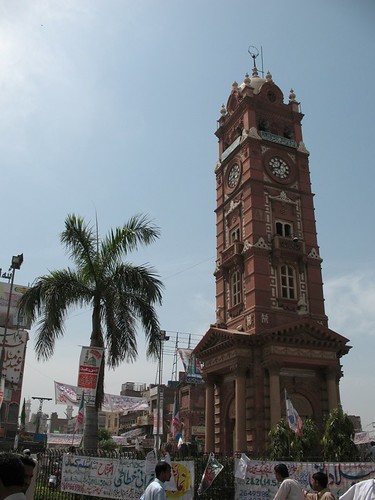
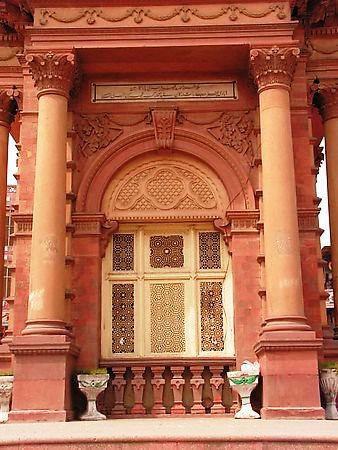
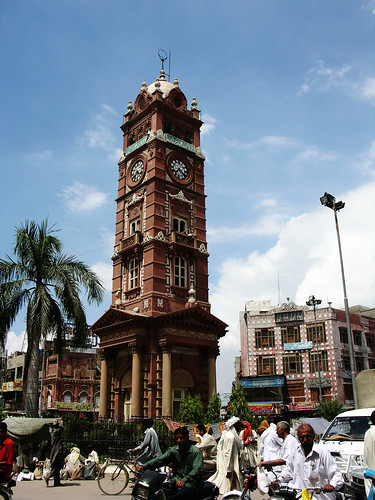
Faisalabad Clock Tower

The Faisalabad Clock Tower is a clock tower in Faisalabad, Punjab, Pakistan, and is one of the oldest monuments still standing in its original state from the period of the British Raj. It was built by the British, when they ruled much of the South eastern continent during the nineteenth century. The majestic Clock Tower of Lyallpur was constructed out of the funds raised by the Sikh Zamindars who collected it at a rate of Rs. 18 per square of land. The fund thus raised was handed over to the Municipal Committee which undertook to complete the project.

For More Information Click Here

More Pics: [CLICK 2 ENLARGE]

January 30, 2009

Pakistani History

Pre-Independence & Creation


Pakistan is land to some of the oldest civilizations known to man and was the site of several ancient cultures including the Neolithic Era Mehrgarh and the Bronze Era Indus Valley Civilization (2500 BCE – 1500 BCE) at Harappa and Mohenjo-Daro. Waves of conquerors and migrants from the west — including Harappan, Indo-Aryan, Persian, Greek, Saka, Parthian, Kushan, Hephthalite, Afghan, Arab, Turkics and Mughal  settled in the region throughout the centuries, influencing the locals and being absorbed among them. In 712 Common Era, the Arab general Muhammad bin Qasim conquered Sindh and Multan in southern Punjab. The Pakistan government's official chronology states that "its foundation was laid" as a result of this conquest. This Arab and Islamic victory would set the stage for several successive Muslim empires in South Asia, including the Ghaznavid Empire, the Ghorid Kingdom, the Delhi Sultanate and the Mughal Empire. During this period, Sufi missionaries played a pivotal role in converting a majority of the regional Buddhist and Hindu population to Islam. The gradual decline of the Mughal Empire in the early eighteenth century provided opportunities for the Afghans, Balochis and Sikhs to exercise control over large areas until the British East India Company gained control over South Asia. Although the region advanced in many ways under the British Rule, the locals eventually resisted foriegn rule over their land. The 1857 War of Independence, also known as the Sepoy Mutiny, was the region's last major armed struggle against British Raj and it laid the foundations for the generally unarmed freedom struggle, led by the Hindu-majority Indian National Congress in the twentieth century. The All India Muslim League rose to popularity in the late 1930s amid fears of under-representation and neglect of Muslims in politics. Led by Muhammad Ali Jinnah and the Muslim League the Pakistan movement resulted in the independence and creation of the state of Pakistan. The name Pakistan stands for "Land of Pure" in both urdu and farsi. It was coined in 1934 as Pakstan by Choudhary Rahmat Ali, who published it in his pamphlet "Now or Never" [Pakistan Declaration].The name represented the "thirty million muslims of PAKISTAN, who live in the 5 Northern Units of British India—
Punjab,
Afghania (now known as North-West Frontier Province & FATA),
Kashmir,
Sindh, and
BalochisTAN.
Post Independence
The modern state of Pakistan was established on August 14, 1947 with 2 wings: East Pakistan [now Bangladesh] & West Pakistan [modern day Pakistan]. [See Image Below]


From 1947 to 1956, Pakistan was a Dominion in the Commonwealth of Nations. It officially became a republic in 1956 but civilian rule was stalled by a coup d’état by General Ayub Khan, who was president during 1958–69, a period of internal instability and a second war with India in 1965. His successor, Yahya Khan (1969–71) had to deal with a devastating cyclone — which caused 500,000 deaths in East Pakistan — and also face a civil war in 1971. With incredible interference from India [India was also involved causing economical and political instability in East Pakistan], East Pakistan successfully seceded from West Pakistan and created a nation of Bangladesh. Civilian rule resumed in Pakistan from 1972 to 1977 under Zulfikar Ali Bhutto, until he was deposed and later sentenced to death (in charges of murder) in 1979 by General Zia-ul-Haq [Pakistan's 3rd military president]. Zia introduced the Islamic Sharia legal code, which increased religious influences on the civil service and the military. With the death of President Zia in a plane crash in 1988, Benazir Bhutto, daughter of Zulfikar Ali Bhutto, was elected as the first female Prime Minister of Pakistan. Over the next decade, she fought for power with Nawaz Sharif as the country's political and economic situation worsened. Military tensions in the Kargil conflict with India was followed by a Pakistani military coup d'état in 1999 in which General Pervez Musharraf assumed executive powers. In 2001, Musharraf became President after the controversial resignation of Rafiq Tarar. On 15 November 2007 the National Assembly completed its tenure and new elections were called. The exiled political leaders Benazir Bhutto and Nawaz Sharif were permitted to return to Pakistan. However, the assassination of Benazir Bhutto in December during election campaign led to postponement of elections and nationwide riots. Bhutto's Pakistan Peoples Party (PPP) won most number of seats in the elections held in February, 2008 and its member Yousaf Raza Gillani was sworn in as Prime Minister. On 18 August, 2008 Pervez Musharaff resigned from the presidency when faced with impeachment.

TO ADD A COMMENT CLICK ON THE COMMENTS LINK UNDER NEW POST